Showing posts with label desert. Show all posts

Wednesday, October 5, 2011

Morning Meal


Morning Meal. I approached a fork in the trail with dawn to my right and had to choose between left or right. I chose to stay down and away from the light a little longer and went left. This led me to pine tree arch. The arch is gouged out of the right side of a narrow corridor between two sandstone fins. The arch opens up to a downward sloping field of sand and low scrub flanked by walls of stone.

I sat in the sand at the top of the scrub field between the two stone ridges with the rising sun casting the shadow of pinetree arch onto the wall behind me. The first thing that I began to notice was that there was no wind and with no wind the scrubs weren't chattering and the loose sand wasn't rolling along the foot of the stone. I watched swirling clouds of mosquitoes rising from the scrub to look for a mate as my ears grew accustomed to this aural stillness. Then a new sound cut through my deafness, a slicing of the still air and a ruffle of feathers. The first of it was barely audible and as I turned to look for the bird, another slid through the air right above my head. The only sound produced was that of the Western Meadowlark's slender shape shearing the still air as it glided through the circling column of mosquitoes. There was then a rippling sound as the bird flapped his wings to circle a boulder at the edge of the field and dove through the mosquitoes once more. Soon there were three birds sweeping back and forth, three feet from the ground. If I was quick I could have grabbed one from where I sat.

As I sat watching the birds have their morning meal I became aware of some reddish ants toiling near my feet. Soon, I could hear them too; tossing sand as they scrambled over pebbles. I almost thought I could hear the stridulation exchanged between ant compatriots on their linear path to and from their occupation. I got onto my knees and put my face near the sand to get a closer look at the ants. Some of them seemed to have strange bulges on their abdomen that looked like grains of sand had merged with their bodies. As I looked around, I saw that every open sandy space was covered in ants. I wondered if these were all from the same colony and if not, how far did these ants travel from this particular patch of sand over the course of their lives.

Now, within the shuffling of the ants and the rushing of the meadowlarks I heard the scratching of small rodent claws on a boulder 10 feet away and turned to see a kangaroo rat sitting on top of the rock. I watched her for a while as she waited on the boulder hoping to conceal herself from my gaze by remaining motionless. I slowly rose to walk over for a closer look. As I began to walk slowly towards the boulder my shins ached. I looked down, wondering if I had really been sitting that long only to find a dozen ants clinging to my legs, bravely trying to drive me away from their colony. Now that I noticed them the pain began to grow rapidly and I quickly brushed them off. This was not before they had produced red marks the size of a 50 cent piece on my shins. With the pain of the bites subsiding I made to continue my pursuit of the rat only to see that she had taken advantage of my preoccupation with those jingoistic ants to make good her escape.

As I made my way back up the hill I heard one last sound, the scraping of hiking boots over the rocks as another hiker emerged from the arch into the scrub field. I could no longer hear the sounds of the meadowlark and the ant and the rat, only the ordinary daily sounds of sand on boot soles and zippers clicking and jacket swishing. The morning was over and the day had begun and I made my way out of the field. As I left, I turned to look at the boulder and saw that the kangaroo rat had resumed her place at its summit.

Tuesday, September 6, 2011


A visit to Arches National Park benefits from a knowledge of the history of the geological oddities that have formed in the area over the last 150 million years. This way, when you're looking at a prime example of a fin arch like Skyline Arch, you can also realize that you're standing on top of what was once an ocean, then a 2 mile tall pillar of salt. You're also standing under the space were 5000 additional feet of sediment had settled before being washed away to reveal the 140 million year old entrada sandstone that forms the arch you now see.

The mechanisms that generated Arches National Park were set in motion at the bottom of an ocean 300 million years ago. The paradox basin was a deep bucket with its lip at sea level. As a result, Southern Utah was frequently submerged under an inland sea during interglacial periods when ice thawed and raised sea levels. During each ice age, sea levels would drop as water was collected into glaciers and the inland sea would be cut off from the retreating ocean. As a result, massive volumes of salt and other minerals were collected in the paradox basin as the trapped stagnant seas evaporated.

As this period of flowing and ebbing seas subsided, the great well of salt was being buried beneath sediment washed down from the Uncompahgre uplift to the Northeast. Squeezed beneath thousands of feet of sand and mud, the salt became liquid and flowed southwest in subterranean waves. These saline swells migrated southwest until they crashed into 6000 foot sheer cliffs that had resulted from northwest trending faults in southeast Utah. Their progress halted by these underground walls of stone, the salt began to push upward through the surrounding rock. At the same time, the red entrada sandstone that you see in Arches national park was solidifying at the surface. The intrusive strips of salt bulged and cracked the surface sandstone like a baking loaf of bread, parallel to the underlying fault lines.

These cracks allowed surface water to flow down to the rising salt to dissolve and wash it away to the ocean. This continued until less soluble gypsum left behind as the salt dissolved, formed a cap over the salt pillar and the sandstone collapsed into the void left by the departed salt. The cracks in the sandstone remained access points for water to enter and weather the sandstone. These cracks widened as freezing water broke them apart and wind cleaned them out, eventually leaving the long fins seen in The Devils Garden. Fins are crucial to the formation of arches, because it is the careful demolition of these fins by weathering that allows for holes in the fins to widen into great arches before falling completely.

The other crucial factor in the formation of arches is the composition of the fins. This is another aspect in which the Moab area is exceptional. The hard Entrada sandstone in underlain by the fragile siltstone of the Dewey Bridge member. As you look at the formations in Arches national park, you'll notice that most arches form at the junction between the Entrada and Dewey Bridge layers. The Dewey Bridge stone wears away much more quickly than the entrada and thus the entrada is undercut in many places. After being under such immense pressure for so many years, the newly exposed base of the Entrada layer begins to break apart as a way of decompressing. The pattern of weathering extends radially out from the division of the two strata and eventually widens into an arch. Water accomplishes this weathering by seeping into the cracks in the sandstone and expanding as it freezes, literally pushing out and breaking the stone apart from inside. These holes continue to grow through weathering until the fin becomes unstable and collapses.

Arches in all stages of life can be found in the park. The most recent arch to collapse, Wall Arch, is very close to Landscape Arch, the longest in the park. Landscape Arch is an arch near the end of this life cycle as well. By luck, none of the chunks of stone littering the area around the arch were vital enough to its stability to bring it down when they fell out. Large chunks have fallen out as recently as the 90s and it would appear that there aren't many more pieces that can be removed before this arch falls. At the same time, new arches are growing throughout the park. This means that the Arches National Park that people see 1000 years from now will look quite different than the one we see today. The spectacle of arches can remind us that while orogeny may progress at a ponderously slow pace, noticeable changes to the earth occur within a human lifetime.

Monday, September 5, 2011


Erosion and decay characterize the desert. Everything new in the desert is formed through the destruction of something old. A canyon gets deeper and more grand because older and older layers of rock are eaten away. It is the same for the stone monoliths; at some time, “ground level” was the top of the pillar of stone. Then slowly the ground was broken and washed away and by some luck in the makeup of the stone a pillar remained standing, marking where the earth’s surface used to be. These markers cannot last forever themselves and with the sides of the rock now exposed to the elements, water begins to whittle away the perimeter. Quirks in the distribution of the elements cause the stone to wear unevenly giving us impossibly balanced boulders and arches for a geological instant. These may look eternal in the way that they stand against the sky but they are just the last strands of sea foam that linger on the beach after the retreating wave, they will be reabsorbed into the earth. The obliterated stone will find its way into the Colorado River which will carry it to the sea where it will be pulled under the crust of the earth to be recycled into the matter that will one day emerge as new land from the seam in the middle of the pacific ocean.

Tuesday, July 12, 2011


Deja vu, for most people. Mesa Arch is one of the most photographed features in the American southwest. Not so much the arch itself but the view of the canyons below the La Sal range as seen through the exceptionally well placed arch. If there is anything interesting about so many pictures existing of the same exact scene it is that one can compare the method by which the photographer dealt with the problems inherent in shooting into the sun at sunrise. Much of the landscape is facing away from the sun making it difficult to get a good exposure without blowing out the sky. One trick is to wait until the sun has risen high enough that it can be hidden behind the arch in frame. However, if you wait that long, the twilight glow is completely gone. Another choice is to get tricky with a computer and create a high dynamic range (HDR) photograph by basically blending multiple exposures into one even toned picture (for example, one exposure to get the shadows, one to get the sky and another in between the two). I feel that HDR is a cheat that undermines a photographer's creativity by not forcing him or her to think about how to get the best exposure possible of a scene. "Art from adversity", the hard work and thought that goes into overcoming an obstacle give the photographer a chance to consider the scene at length and the result will make the viewer feel like they are really there in the picture.

There are plenty of incredible recreations of sunrise from this location, my picture isn't really one of them. However, looking at it has the desired effect of placing me back in the morning I recorded it. I stayed there throughout the morning snapping pictures as the sun rose, but this particular picture before the sun had even crested the horizon resonates the most with me. To explain, let me describe how I came to this spot. I was staying in Moab and had decided that I would make the roughly 1 hour drive into Canyonlands NP one morning to watch this famous sunrise. I wasn't really sure of the length of the drive or the trail to the arch so I set out early around 4am in late February. I had seen the abrupt turn off from the highway to Canyonlands the day before but it still surprised me, the sign's reflective paint aged and hard to read in the dark. After leaving the highway the road became much darker with few reflectors to give me an idea of what was more than 50 feet in front of me. For what seemed like miles, the road switchbacked up into the Island in the Sky section of Canyonlands. I knew that this area had been used to raise cattle because it was a large surface surrounded by canyons with only one way out, through a bottle neck. With this in mind, in the pitch dark I imagined that on either side of the road the ground fell away to the canyon floor 200 feet or more below. I hovered over a thin strip of winding road that seemed to be materializing just as I reached it until I found the pull-off for Mesa Arch. As I found the trail head, I still couldn't see any light on the horizon in the direction that I guessed was east. The trail was slightly illuminated by moonlight. As I went I pulled out my flashlight and turned it on, then instantly turned it off again. Without the flashlight I could get just a hint of everything around me. When I had turned it on, my world had shrunk to a disc of light at my feet and my peripheral vision had melted away to darkness. Without the ability to see any movement that may be occurring at my side, the sound of even a single grain of sand shifting became terrifying. I stopped briefly to regain my night vision after turning off the flashlight and the proceeded along the trail. I had begun to see a glow on the horizon when it was suddenly interrupted by a black band. I had arrived at Mesa Arch.

I was all alone and so was able to choose any spot to set up my tripod. I lay down on the cool rock and watched as the sun started to make a halo over the La Sals. As the light grew brighter I began to get glimpses of the canyon floor. Somehow the rocks appeared to me to be still asleep, waiting for the sun to get higher before unleashing their red glow. As the details of the canyon floor emerged I began to piece together what I must have been driving through earlier that morning. While I had been encapsulated in darkness high up on the road, this landscape had been slumbering below. I wanted to capture that moment of realization before the sun came over the horizon and this was the result.

Just as I had finished taking this picture I saw out of the corner of my eye a pinhole of light bouncing down the trail behind me. I flashed my light at the visitor a couple times so that I wouldn't startle him when he reached the arch, as he must have been sure that he'd be the first one there. After greeting him when he arrived, I turned back to look at the canyon and the sun had come up and the rocks had begun to glow red, just like in the many pictures I had seen of this place. I was content knowing that at least for this morning I had been the solitary witness to the waking moments of this landscape.

Saturday, June 11, 2011

The End of Antelope Canyon comes suddenly as you round this corner and the canyon walls melt away on either side to expose you once again to the sunlight which seems all the more harsh after the dim glow of the canyon. Walking through the canyon, its easy to imagine that you are in a cave. The lack of direct sunlight, especially when the sun stays low in the winter months keeps the canyon much cooler than the rest of the area. The Navajo guide that accompanied me told me that a shepherd had once used the canyon as a place to keep her flock safe from the sun in the summer months.

The canyon itself can become very dangerous after rainfall, with flash floods rushing through from rainstorms that may not even be overhead yet. The end of the canyon pictured here would be the upstream end. Standing there I tried to imagine water crashing around this bend, climbing 30 feet up the canyon wall. There is evidence for the height of these flash floods in the form of a tree trunk wedged between two rock faces 40 feet off the ground.

A slot canyon like antelope occurs when a drainage route for a large arid area passes over an especially hard region of stone. Rather than cutting a gently sloping V-shaped canyon into the stone, the flash floods rush through existing cracks in the stone. The path of erosion traces the crack and the canyon is cut deep rather than wide. The narrow, tortuous path creates eddies which in turn cut the curling crests that line the canyon walls, overlapping and blocking out the sun.

Sunday, January 9, 2011


Retraction, my wandering will not be limited by my threshold for enduring cold nights but by the extent to which I can experience isolation without paranoia setting in. I would like to admit that I jumped in a little over my head traveling in to camp in Death Valley alone. I had thought that it would be no different than my experiences camping alone in Arches. I found a spot to sleep on Artist Drive, one of the only concealed roads in Death Valley, and a one-way road to boot. I could face backwards and see anyone who might be coming my way.

The first night was difficult. I couldn't get to sleep at first, I wasn't tired, I had been driving for most of the day and hadn't really exerted myself. When I finally did get to sleep I would begin to dream only to be awoken by headlights shining through my eyelids. I checked my watch to see that it was 3am. Just as the ranger's truck pulled up to evict me I would wake up again to realize that my being discovered had also been a dream.

After hours of 15 minute naps, I decided to give up on sleep around 3:30. I drove the rest of the way through Artist Drive and down to Badwater Basin. It had rained the night before and I thought that I would be able to get close to the water and catch the sunrise. I spent the next hour stargazing, amazed at how much I could see so far from streetlights. Just as the horizon had begun to show the slightest hint of sunrise, I saw a light out of the corner of my eye about 30 feet away. I panicked, feeling extremely vulnerable at the thought that there might have been someone so close to me without my realizing it for who knew how long. I didn't want to shine my flashlight at them, so I set my camera to its highest ISO and propped it on my window sill and set it to a 15 second exposure. I held the camera down low and checked the image and saw nothing but a building containing a pit toilet. Had I seen a light on some kind of ventilation system? I forgot about it and went back to watching the sunrise.

Throughout the day I realized the huge difference between Death Valley and Arches. Arches is near the town of Moab, a relatively large town that is only a 30 minute drive from the park entrance. The park itself requires about 45 minutes to drive from one end to the other. Death Valley on the other hand is near no towns and one can spend 45 minutes driving from one area to another. At the center, there is a gas station with $4.50 gas and $3.00 sodas which is to be avoided, along with an out of place resort hotel with tennis courts, also to be avoided. I quickly realized how comforting it had been to know that I was no more than 45 minutes away from a Wendy's in Moab if I was longing for a hot meal.

Sleep deprived, I returned to my hiding spot on artist drive the next night hoping to finally be able to get a good night's sleep. I decided to record some time lapse movies of the stars passing overhead. You realize how quickly the earth spins when you use the stars for reference. After taking pictures for about an hour, I fell asleep.

I woke again at 3:30 thinking that I had heard the sound of a car passing as I slept. I didn't see anything but decided to move anyway. I wanted to brush my teeth first though. As I brushed, I bent down to look out at the dark sky to see if I could find any of the constellations that had been hanging on the horizon when I had fallen asleep earlier. Then I saw a light sitting on the hilltop right next to my car. It wasn't a star, because it didn't appear round, it was a small irregular orb of light that could only be a flashlight. I watched it for a while, once again feeling intensely vulnerable that someone had gotten so close without my knowledge. The light didn't move, it just remained on the hill, pointed directly at me. I panicked and started the car and took off, toothbrush still in my mouth. I'm not sure why I was so unnerved by a light being aimed at my car, but I couldn't think of any good reason that it should have been there. I drove 10 miles through the rest of artist drive before I stopped and looked back. The light was still there! hovering just over another hill, and now I saw what looked like a tent, illuminated from the inside resting on the edge of a cliff. As I ran through more and more outrageous explanations for what I was seeing, I moved slowly forward in my car. As I moved, I cleared the hill and the "illuminated tent" was revealed to be the top half of the crescent moon. I then searched for the "flashlight" and found it hovering now high in the sky, above the moon. It was Venus, which was passing directly over Gamma Librae in the constellation Libra, the overlap creating the oblong shape I had mistaken for a man-made light. I had noticed Venus just as it had risen over the hill next to me.

Feeling pretty ridiculous, I decided that it was time to get out and head to Utah. I wasn't ready for my experience in Death Valley, and I would have to return another day.

Monday, December 27, 2010

Moving further down the road as it materializes. I'm heading back west during my winter break. I'll be starting in Nevada and heading towards Death Valley. I'd like to also visit Zion and Bryce Canyon, but it will be depend upon the weather. I have no reservations so my wandering will only be limited by my threshold for enduring cold nights.

My flight will be arriving in Las Vegas after dark, so I will enter Death Valley not knowing what I'm driving through until the next morning, which is the best way to see a new place. As I've said before, seeing a place for the first time at night gives you a chance to get a feel for the environment through your more basic senses without biasing yourself through sight. Even when the sun rises and you can finally see your surroundings, the impression on your other senses will always remain to enrich your experience there.

Thursday, December 9, 2010


Lush could be the word used to describe the environment at the bottom of a canyon. The running water that creates the canyon gives rise to an explosion of vegetation in comparison to the rest of the desert. The canyon walls provide the shade that keeps the sun from baking the plants and stealing the water that they retrieved from the stream. This makes a canyon one of the most pleasant places to hike in the desert. Following the meandering stream gives your walk just the right type of aimlessness. The curve of the canyon wall always keeps you motivated to keep going in order to find out what is behind the bulging wall in the distance.

Scale is not easily conveyed. One of the best things about seeing Arches for the first time is the realization of the size of its features. You’ll lie under an arch and realize you could fit a house inside, or even a small building. You even really get an idea of how big they are just by looking at them in person, you have to hear them. The echo of your shoe scuffing against loose sand and pebbles that you kick down while climbing give you the subconscious realization of these massive forms. To record all of these impressions in a picture and then transmit those feelings to a person who has never visited the place is impossible. The challenges in landscape photography are similar to those in architectural photography. The spot must be found where the features being photographed are arranged in such a way through the viewfinder that their organization will convey to the viewer of the photograph an understanding of the space. Being at the actual site, binocular vision and the way that the shapes change as we move around help us understand a space. When that space is compressed into a two dimensional image, we need clear hints of where the edges of the foreground give way to the background. Adjusting a highlight or darkening a shadow can guide the viewer’s eye to important features, making parts of the picture stand out and giving it depth. It also always helps to throw in a recognizable object to give a sense of scale. By the way, can you spot the person sitting with their body silhouetted against the sky?

Tuesday, September 28, 2010

A lack of trees and a distance from city lights are the things that make stargazing in the desert so wonderful. Arches NP is dangerously close to the city of Moab with its flood-lit hotel parking lots and even a spinning spotlight occasionally. On the night where I was waiting out a big storm in my car parked on the side of the park road I had a high vantage point facing towards moab looking out over the petrified sand dunes. As the storm passed and lightning struck I saw an orange glow in the distance and was sure that lightning had started a fire somewhere in the park. It was only later when I was trying to take pictures of the night sky that I realized this orange glow was actually the lights of Moab polluting the sky. Luckily, Moab is the only city around so the lights can be escaped if you retreat deep enough into the park.

Skyline arch is on the side of Arches opposite Moab and at a much higher elevation. At this height and with this sparse landscape you can see stars all the way down to the horizon line, something impossible from beneath the screen of dense vegetation on the east coast. Whenever I looked at the night sky, I felt like the stars were receding into the sky as I focused on them. I could catch a glimpse of the brilliantly speckled sky out of the corner of my eye with its superior night vision only to have the stars retreat when I turned to look. I think this is why a person can spend so long staring at the night sky. Your eyes dart back and forth almost beyond your control trying to catch a dense patch of stars that always seems to be just out of view.

Monday, August 23, 2010

The mountains behind the dunes were hidden by the haze of blowing sand. The experience of walking on windblown sand would be familiar to anyone who has stood in the shallow tide at the beach. Everywhere you place your foot, the wind starts to carve away sand, undermining your stance. The sand drifting close to the ground shimmers like a silk sheet, creating the optical illusion that you are walking the wrong way on a great conveyor belt. Without the proper equipment, it was all that I could do to keep the sand out of my ears and eyes. I had to walk with my head down, only rarely glancing up to get my bearings and adjust my walking trajectory. The path that I chose to the top of the dune was deceptively shallow looking with nothing by which to judge the scale of the dune. As I started to climb I felt like I was under a cresting wave, being pulled down by a current of sand as a wall grew in front of me. When I finally gave up trying to climb the dune, I turned around to find myself in a pit with steep slopes on all sides. As I tried to climb out, the wind was dumping sand over the edge of the dune and the ground beneath me was sliding back into the pit faster than I could climb out. I finally found a seam where two slopes met and by staying in the seam which was relatively shielded from the wind was able to slowly crawl over the rim of the pit. Now, completely turned around I was barely able to make out the treeline from whence I had entered the dune field and made my way towards it. Safely under the cover of trees I spent the next 45 minutes dumping sand out of my clothes and brushing it from inside my ears and around my eyes.

Friday, July 9, 2010


My favorite memory of Arches National Park. Watching this slow sunrise I finally realized where the feeling I get when looking at a desert landscape comes from, it’s the shadows. Shadows in the desert are unlike those anywhere else in the world. Clouds rarely gather above this landscape and there are no tall trees to filter and scatter the light. There’s just the sandstone, linked directly to the sun. The stone is tied to the sun to such a degree that they change shape depending on the sun’s position in the sky. Taking this scene as an example, I arrived when the sun was still just a faint glow on the horizon and sat for three hours watching the scene move. First, the wavy stone in the background slithered into the light, followed by the wall on the right looking like a door opened to a lighted room. Then the great fin at the center started to surface in a lake of darkness. As the sun rose higher I could start to see a face in the distant wall, as time passed the brow appeared to swell and the chin receded while the loop of shadow cast by delicate arch swung down the adjacent incline. All of these pieces were moving like parts of a giant clock. It was cold and I was losing feeling in the skin where I was sitting but I was riveted to the spot waiting to see what would happen next.

I met a photographer who was complaining that everything he took a picture of was too bright or too dark or some combination of the two. To me, a picture with inky shadows and burning highlights is a realistic depiction of the desert, it’s the way that it looks when you pupils are constricted from the bright sunlight and you’re looking around for a shady spot to rest.


Thursday, June 17, 2010

The unexpected detour will often prove to be the highlight of your day. I was driving around the outside perimeter of Arches NP looking for a view that I might like to revisit at sunrise the next day when I spotted a sign for a trail that I had not read about. It was a 5 mile out-and-back trail through Negro Bill Canyon. First, a bit on the etymology of this particular canyon. The name, which has obviously been awkwardly reworked into something only slightly less offensive actually refers to a part black cowboy named William Granstaff who ran cattle here in the late 19th century. I was surprised to learn that despite the seemingly racist overtones of the name, it referred to a man who, by what I can tell, was a business partner in equal standing with white cowboys in the 1870s.
The trail through the canyon is exceptional. You crisscross the canyon floor and climb up and down the canyon walls to work your way upstream without getting wet. The trail ends at Morning Glory Natural Bridge, which is one of the largest natural arches in the world with a span of 243 feet. It is also not technically a "bridge". A bridge is what an arch is called when it spans over running water. This distinction has to do with the mechanisms that formed the arch, running water being a very different process from normal weathering. However, this arch is merely next to a running stream and was actually formed by the collapse of part of the wall it is attached to, the correct term being "alcove arch".
As I made my way along this trail, I apparently missed one of the points where the trail crossed the stream and I continued further along the narrowing bank. Eventually the stream came so close to the canyon wall that I had to shuffle sideways with my back against the wall to continue. I had just completed a tricky jump and balance maneuver on a tiny rock in the stream when I noticed a couple of hikers on the opposite side of the stream. I asked them where they had switched sides and it was far enough back that I decided to risk it and hop the rest of the way across the stream.
As I caught my breath on the other side, I took a drink from my water bottle and noticed that it was already half empty. I hadn't thought to refill it before setting out from Arches not knowing that I'd be doing any long hikes. The trail had been pretty level so far, but I resolved that I'd turn back once I had drank half of what I had left.
Just around the next bend, the canyon walls narrowed and progress was made only by alternately scaling and descending the sandy cliff base. Not knowing the distance to the end of the trail I tried to ration my water intake, but still found the canteen quickly depleted. Just as I was about to turn back, I spotted the natural bridge in the distance. I realized that it would be unwise to continue and had to admire the bridge from a distance content in the knowledge that i would return again someday soon.
Dark wedges in the starry sky was the form that the sandstone skyscapers of park avenue took the first time that I saw them. I was heading into Arches for the first time ever at 4 in the morning. The sun had not yet started to glow behind the La Sal mountains in the distance and I was driving the winding road up into the park. Looking ahead, I could not tell whether I was looking into the distant expanse of the petrified dunes or surrounded by cliffs looming overhead. Then I turned the corner leading to park avenue and I realized that the sky was not black, but riddled with more stars than I had ever seen. What I thought had been the black sky were the forms of sandstone cliffs towering over the road leading into the park. Having no sense of where I was, a strong feeling of uneasiness set in as I looked up at these dark forms that always appeared to be moving from the corner of my eye. However when I turned that corner and saw the shapes of these rock formations outlined in stars I knew instantly where I was. This view had become very familiar to me through the countless pictures I had found of the site while I was longing to visit Arches. They were unmistakeable, but so much larger than I had imagined. It was when I saw this that I finally felt that rush of being "there" where I had wanted to be for so long.

The effect may have been comparable if I had seen all of this for the first time during daylight, but I don't think that anything can compare to those magical hours that I spent in the park before sunrise that first day. Both the familiar and unexpected where slowly revealed as the sun rose, allowing me to compare what I had imagined during the pitch black drive in to the reality of my surroundings.

Friday, June 11, 2010

Privacy is the best part of visiting the southwest during the winter. In late February, snow has become less frequent and daytime temperatures begin to climb out of the 50s making hiking through the desert extremely pleasant. However, this is not the best part of this time of year. For some reason, possibly because people don't believe in wearing jackets in the desert, most of the parks and sites in the southwest are all but deserted this time of year. You may still run into other tourists at the ranger station or at the most famous sites like delicate arch and mesa arch but the vast majority of your time will be spent alone, the way it should be in the desert.

Not having a vehicle capable of traversing the washboard like riverbed leading to Antelope Canyon, I had to get a ride from one of the Navajo men that oversee the site. Luckily, I was the only one who showed up and was able to have my own personal guide through the area. If there where any place that fosters a desire for solitude it would be Antelope Canyon. Early in the year, the sun never gets high enough in the sky to crest the walls of the narrow canyon. The light, reflected back and forth between walls of navajo sandstone, fills the canyon with a warm glow. The dappled light gives one the impression of walking through a dense forest. The temperature, kept low due to lack of sunlight, feels like it would in a cave. The Navajo do their part to restrict the number of tourists in the canyon during peak seasons to help preserve the site as well as to allow each person a glimpse of the sublime solitude contained within.

Sunday, May 9, 2010


"Visit Goblin Valley State Park". This is what I was told by another hiker I met on a cliff behind the south window arch at 4am. He was dragging his wife who had just had foot surgery up a rocky trail so that they could watch the rising sun impart a glowing red hue to the arch. He told me that he had gone there about 10 years ago on the recommendation of a guy he had just happened to meet as well. He hadn't arrived until after dark and so he grabbed his sleeping bag and walked down into the valley without any notion of the sandstone mushrooms surrounding him. Apparently the experience of seeing these "goblins" for the first time when you open your eyes after a short night's sleep could be described as surreal. Actually he said he was unsure of whether or not he was actually back in his dorm room in Salt Lake City sleeping off some variety of intoxication.

For me, the experience was surreal in a different way. I had been in Arches for a few days which, while beautiful throughout, is focused on certain points of interest. In goblin valley there really is no destination when you begin your hike, nor is there really any trail. You merely drop down a short incline into the valley and choose a direction in which to wander. The "goblins" (I prefer their original name "mushrooms") look mostly identical with some standing alone or in pairs and others clustered together. At the far side of the valley the wall stands roughly 50 feet above the valley floor and is riddled with short tunnels and bubbly protrusions that made me feel like I was in an anthill. If you follow this wall, you can eventually find your way into a "side valley" where the mushrooms get taller and more irregular in shape.

The mushrooms are apparently formed of eroded sandstone but after the previous day's rain everything felt soft. To me it seemed like I could have smashed the formations with the swing of a shovel or something. I also left deep footprints in the spongy ground as I walked around. Unfortunately I entered the park with my water bottle half full and ran out pretty quickly while walking and had to turn back before I had explored the rest of the area.

Sunday, May 2, 2010


The trail, part three. This is from a different part of arches, "The Fiery Furnace" a maze of narrow paths and dark pits. It can be so disorienting that the visitors center recommends that you enter with a ranger if you've never been before. I gladly took them up on the offer. Our ranger-guide must have been pushing 70 but it was a delight to see him climbing over boulders and sliding through narrow cracks while the rest of up were fighting to keep up. He also provided interesting explanations of the surrounding environment.

One detail that would prove crucial to me at a later time was his explanation of the effect of rain on exposed sandstone. The cement that holds the sandstone in Arches together is calcium carbonate. Calcium carbonate can be dissolved when it reacts with water and carbon dioxide. It just so happens that rain water accumulates enough carbon dioxide on its descent to earth that it creates just such a reaction. The result is that after a rain storm, the surfaces of sandstone boulders are covered in a thin layer of the sand left behind when its CaCO3 matrix dissolved.

The reason that this was so important to me is because I prefer to wear tennis shoes while hiking. I think that they are much more comfortable, and their shallow treads provide a great amount of friction on dry, rough sandstone. Once the rain storm happened, the sandstone began to act as a course grade sandpaper on the soles of my shoes, reducing my shallow treads to a smooth rubber in less than a day of hiking. Once this had happened, wet sand began to cling to the bottoms of my shoes. These sand grains acted as little ball bearings making it impossible for me to stand on more than a 10 degree incline before I would start to slowly slide away.

This was merely a source of annoyance and mild peril until I approached the flooded wash which I described in an earlier post. As I said, there were two options, find another route or wade waist-deep through the puddle which was about 30 feet across. Other hikers were arriving often enough that I decided not to risk taking off my pants to wade through and decided to find another route. I eventually determined that this was the only passage though an otherwise immense fin of sandstone that stretched as far as I could see in either direction. There was however a large and lumpy boulder sitting on one side of the puddle that would allow for dry passage provided that one could get on top of it. I tried every approach to climbing the boulder but just as I would reach for a handhold to pull myself up the last step, my useless shoes would invariably slip and send me bouncing down the side of the boulder. The humiliating thing was that the boulder really wasn't that steep. As some snooty kid would gleefully demonstrate to me, with a good pair of shoes you could run right up the side of it.

Eventually I decided to go back and find the biggest fallen tree branch that I could and try to plant it in the water as a step to where I could grab an easy handhold on the side of the boulder. The branch I found was roughly T shaped and quite flexible. As I edged myself towards the water, branch in hand, I started to slide towards the puddle and threw my hands out to stop myself. When I slammed the T shaped branch down in my hand, the three prongs stuck to the stone and stopped me instantly. What a wonderful invention! The wooden climbing claw was what I decided to call it as it allowed me to easily hoist myself up the side of the boulder to safety.

Once I had reached the other side another group of hikers came into view. I called over to them and explained what I had done to get by and told them that I'd toss them the stick that I had used. I hurled the stick with amazing inaccuracy, bouncing it off the wall and depositing it in the middle of the puddle. Without saying another word I just turned around and continued with my hike. Figuring out how to get over that puddle was the most fun part of my day and I realized I shouldn't deny them of the same pleasure.

Don't be lazy! Turret Arch, Double Arch, the North and South Widows are all visible from a paved parking lot in Arches National Park. Many visitors take advantage of this, taking their pictures only a few yards from the start of the trail, just enough to hide the fact that they're standing next to the sign-post announcing the beginning of the trail. People generally don't enjoy long car rides but wide open national parks seem to make them crave the confines of an automobile, I even saw one family photograph this entire area drive-by style except they didn't roll down their windows to shoot.

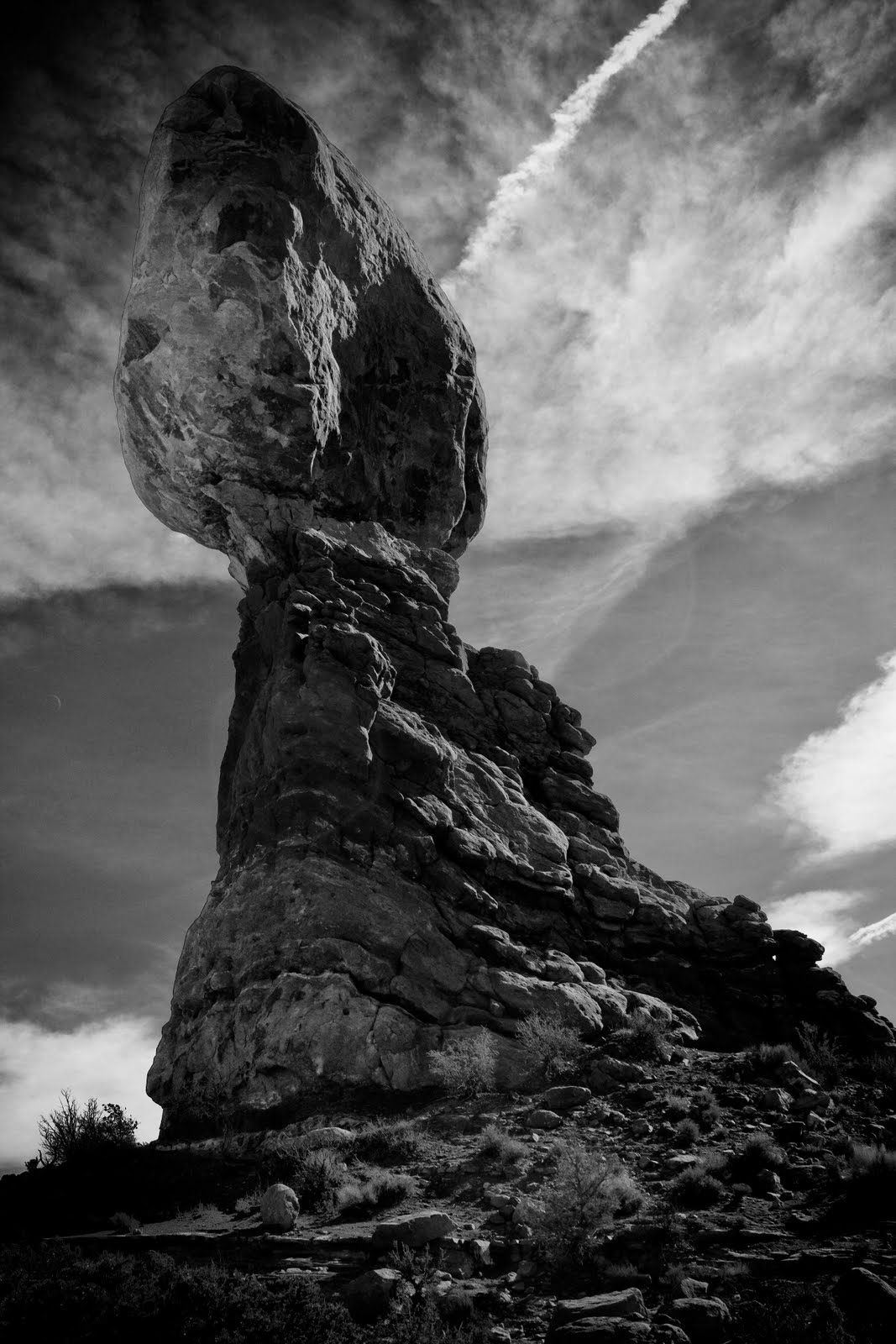
What that family did miss was this little tree, half dead, growing in a mud pit below the grand turret arch, but somehow even more impressive than the arch itself. It seems like such a perfect place for a little tree to grow that I can only imagine that this spot has been occupied by a long line of trees for as long as this arch has been in existence. So while the family on wheels was probably already rolling past balanced rock I was slipping down rocky slopes and landing in muddy potholes, climbing up to get a better view and running across narrow passes trying not to fall 30 feet to the ground below.

In the book Desert Solitaire, Edward Abbey laments the attempts by the Government to make Arches more accessible with paved roads to every attraction. Well, even those roads failed, they'll have to pave the trails and rent out ATVs if they really want to force those ungrateful to see the outdoors.

The Trail, part two. Like a giant head stone this fin marks the entrance to the Devil's Garden in Arches National Park. The name Devil's Garden seems contradictory to me, with "devil" implying a hot and arid environment and "garden" implying some sanctuary of green in an area otherwise covered in tumbleweed. I can't speak for the heat, as I always come here just at the tail end of winter when snow still falls, but the plant life really is unlike what you'll see anywhere else in the park. Junipers and Pinyon Pines are in relative abundance here enjoying the way that water lingers in the convoluted washes that form between the fins.

Parts of these washes can remain flooded for days after a heavy rain or even on a sunny day in my case when snow begins to melt rapidly. This renders some portions of trails impassable due to flooding, leaving you a choice to double back and try to find another route around a wide and deep puddle or accept a cold and squishy hike of the remaining miles after wading through. I was faced with this choice on one occasion and I chose to climb around the puddle. This course of action was complicated by conditions that I will detail in subsequent posts.

Sometimes you've got to be a little bit selfish. This is Delicate Arch, which almost anyone who has seen its likeness on a Utah license plate would know is located in Arches National Park in Utah. On websites like flickr you can find hundreds of pictures of Delicate Arch that look exactly like the one on Utah's license plate. The reason for this is that not only is Delicate Arch a dramatic example of the beauty of collapsing sand stone but it is oriented in such a way that the setting sun lights up the inside of the arch with red light on a clear day. On any given day you will find at least 20 photographers setting up tripods to catch this event, praying that clouds on the western horizon don't ruin their shot. They will wait for hours for the light sun to move into just the right position. They will fiddle with their composition trying to frame the La Sal mountains in the distance with the arch. They will pass around business cards for their respective wedding photography businesses. They will also wish death on any ignorant soul who dares to actually walk up to Delicate Arch as the sun is setting to get a unique view of the awesome and surprisingly large structure.

The first time that I visited Delicate Arch I joined them and set up shop on the side of the amphitheater opposite the arch. I waited there for 2 hours as the sun set, only for it to duck behind some low clouds just as it was beginning to burn red. Some of the photographers looked like they were going to cry! I kicked myself for wasting two hours trying to get a picture that I could have bought a poster of in the gift shop.

When I came back a year later I was determined not to make the same mistake. Once I had made the climb up to Delicate Arch, I got up close from every possible angle. There are steep drop-offs "behind" Delicate Arch making the task of photographing the lesser seen side into a small adventure even requiring an alternate approach along an unmarked trail to safely reach one side (unless you have some really grippy shoes). Once I had reached the back of the arch, I tried my best to stay out of the way of the audience on the other side of the amphitheater but the place has great acoustics and I could hear much grumbling from those on the other side.

The lesson here is to never be afraid of moving away from the crowd to get a different shot of something well known. The people who insist that the only way to photograph landmarks like Delicate Arch is from the "kodak spot" are killing creativity and ruining your vacation! Let people walk into your pictures, they give them a sense of scale. If you're trying to portray desolation at Delicate Arch, you're not fooling anyone who's ever been there. If you're really intent on joining the horde of people selling the same post card, invest in photoshop and clone the people out.